

Power bank capacity explained in plain terms: capacity is measured in milliamp-hours, and the number printed on the device isn’t what your phone actually receives. A 10,000 mAh power bank typically delivers about 6,000 to 7,000 mAh of real charge because of voltage conversion and heat loss. This guide covers how that conversion works, how to read the labels, and what capacity fits different devices.
What power bank capacity means
Photo: rollingsquare.com on Google
Capacity tells you how much energy a power bank stores, printed on the casing. A rating indicates the internal battery’s energy storage, which a technician should measure if verification is required. You use this number to compare sizes and to estimate how many phone charges you’ll get.
The misconception is that the printed number is what reaches your phone. It’s not. Power banks store energy internally, but USB output requires voltage conversion, so some energy is lost when the voltage is stepped up. More is lost as heat inside the circuits and in the cable. A phone battery also charges at its own voltage, creating another conversion step that a technician should assess.
Think of the capacity rating as the total fuel in a tank, rather than the distance a car can travel. Efficiency losses act like friction or engine idling. If you choose a power bank for high-drain devices like tablets, the internal voltage conversion works harder, which consumes more energy.
The useful output is what matters, not the cell rating. Always look for the rated capacity if the manufacturer provides it, as this reflects the actual energy available after the internal conversion process.
How to work out real capacity
A power bank’s real output is lower than its printed rating because of conversion losses. Follow these steps to estimate what you’ll actually get.
- Find the printed capacity in mAh on the casing, such as 10,000 mAh.
- Calculate the total energy capacity; this is a technical assessment that should be performed by a professional.
- Assume about 80 to 85 percent efficiency after voltage conversion, heat, and cable loss, leaving roughly 30 Wh usable.
- Determine the usable capacity by accounting for conversion losses; this is a technical assessment that should be performed by a professional.
- Divide that by your phone’s battery capacity to estimate full charges, so a 4,000 mAh phone gets just under two full charges.
- Subtract about 10 percent more if you use the phone while it charges, since screen and processor draw add to the drain.
The single judgement call is efficiency: cheap banks often lose more energy to heat than well-built ones, so assume the lower end of the range unless the brand publishes test data.
Capacity and output at a glance
The table below shows typical usable output for common printed sizes, assuming average conversion efficiency and a standard phone battery.
| Printed capacity | Approx. usable output | Typical phone charges | What to watch for |
|---|---|---|---|
| 5,000 mAh | 3,000–3,500 mAh | About one full charge | Pocket size, slow charging |
| 10,000 mAh | 6,000–7,000 mAh | About two full charges | Best balance of size and power |
| 20,000 mAh | 12,000–14,000 mAh | About four full charges | Heavier, may exceed airline carry-on limits |
| 30,000 mAh | 18,000–21,000 mAh | About six full charges | Bulky, often needs two USB ports |
A printed figure in mAh alone doesn’t tell the whole story. Watt-hours matter for air travel, and airlines often limit power banks to 100 Wh without approval. The US Transportation Security Administration publishes guidance on carrying power banks on planes. Check your phone’s battery size and the bank’s output ports before buying, since a small bank with fast charging can outperform a large one with weak output.
Details that separate good results from bad ones
Experienced buyers check the output rating, not just the capacity. A 20,000 mAh bank with a single 5-volt, 1-amp port charges phones slowly, while a smaller bank with 18-watt USB-C output can refill a modern phone much faster. Look for the output wattage printed near the ports and match it to what your phone supports.
They also check the battery type. Lithium-polymer cells are usually slimmer and hold their shape better over time, while lithium-ion cells are common in larger, cheaper banks. Neither type is dangerous in normal use, but both degrade if kept at full charge in high heat for long periods.
Partway through a trip, check whether the bank is warm. Some warmth is normal during charging, but a hot bank means poor conversion or a failing cell, and you should stop using it. Leave the bank alone while it charges your phone; using the phone heavily while it charges adds heat and slows everything down.
Problems you might see and what to do
| What you notice | What it usually means | What to do first |
|---|---|---|
| Phone charges very slowly | Low output port or weak cable | Try a different cable and the highest-output port |
| Bank feels hot during use | Conversion loss or high draw | Unplug it, let it cool, avoid using the phone while charging |
| Bank won’t hold a charge | Aged cells or deep discharge | Charge fully once; replace if it still drops quickly |
| Lights flash but no output | Port fault or safety cutoff | Try another device and cable, then contact the maker |
Slow charging often stems from a mismatch between the cable’s data capacity and the power bank’s output. If your cable is frayed or designed only for data transfer, it will bottleneck the current regardless of the port’s rating. Always test with a short, high-quality cable before assuming the bank is faulty.
Heat during operation is normal to a degree, as energy is lost as heat during voltage conversion. However, if the surface becomes painful to touch, the internal circuitry is struggling to manage the load. Disconnecting the device allows the internal battery and circuitry to cool down.
If the bank swells, leaks, or smells unusual, stop using it immediately and recycle it properly. These are signs of chemical cell failure, not a simple settings problem. Never attempt to open the casing to inspect these cells yourself.
Rules and checks before you buy
No single government rule sets power bank capacity for everyday buyers, so this section covers what to confirm for your own case rather than a legal limit. Look up these five things before you buy.
First, check your phone’s battery capacity in mAh, found in its specifications, so you can estimate charges from the table above. Second, confirm the airline limit if you plan to fly; most carriers follow the 100 Wh carry-on guideline without prior approval, but rules vary by airline and country.
Third, check the output ports and wattage against your phone’s fast-charging needs. Fourth, confirm whether the bank is allowed in checked luggage — it usually is not, and must go in carry-on bags. Fifth, check the warranty and return policy, since capacity ratings can be overstated on no-name brands.
If you need help choosing a safe model or understanding airline rules, contact the airline directly or the power bank’s manufacturer before you travel.
Keeping it ready for next time
Store your power bank at about half charge in a cool, dry place if you won’t use it for weeks. A fully charged or fully empty battery left in storage degrades faster than one kept in the middle range. Recharge it every three to six months so the cells don’t drop so low that they become hard to revive.
Keep the cable and ports clean and dry. Moisture in a USB port can short the circuit, and a damaged cable loses power as heat.
There’s no fixed expiry date printed on most banks; the sign that it needs attention is when it no longer charges your phone to the same level it once did, or when it takes much longer to recharge itself. Bring it back to full before a trip, and don’t leave it in a hot car, where heat permanently reduces capacity.
When a power bank is the wrong choice
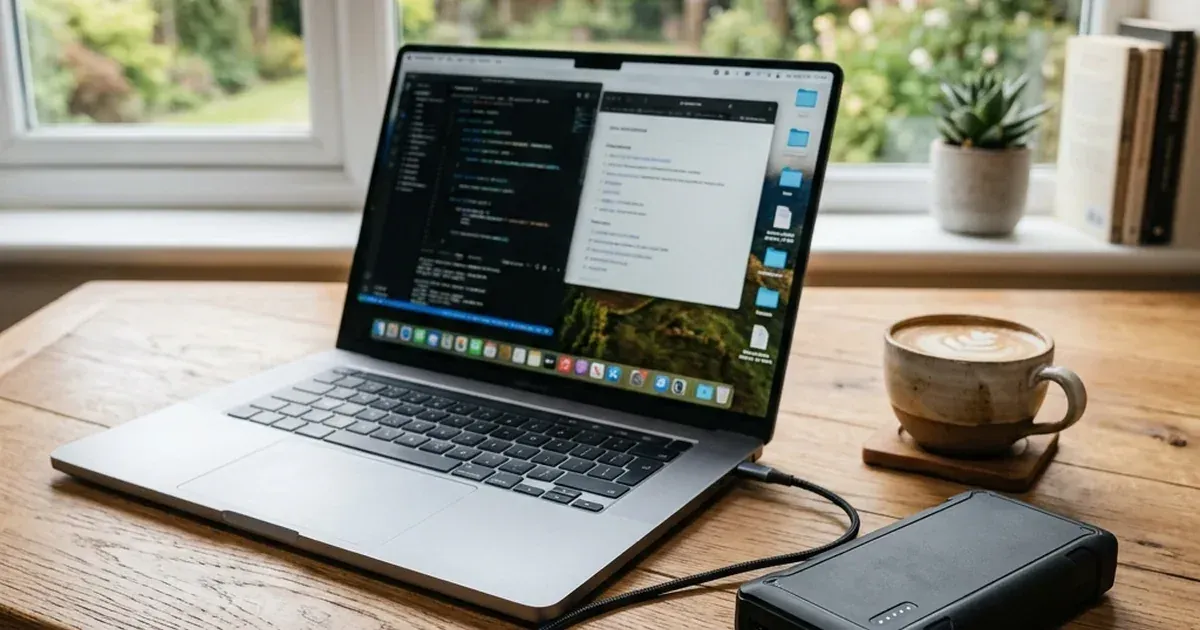
A small power bank is the wrong choice for a laptop. Most laptops need 45 watts or more over USB-C, and many compact banks top out at 10 or 15 watts. If you try to charge a laptop with an underpowered bank, the device will likely reject the connection or drain its own battery faster than the bank can replenish it. Use a dedicated laptop charger or a high-capacity bank rated for your laptop’s wattage instead.
It’s also the wrong choice if you need power for days off-grid. A 20,000 mAh bank gives a few phone charges, not a week of power. When you’re away from civilization, you need a reliable energy source that can handle sustained demand. A portable solar panel paired with a portable power station, or a set of spare charged batteries, fits that job much better.
Finally, don’t rely on a power bank for medical devices or critical equipment unless the manufacturer explicitly rates it for that use. A phone can wait for a charge; a medical device cannot. Plug critical gear into wall power or use equipment the device maker approves to ensure consistent, life-sustaining performance.
Related guides
Frequently asked questions
Is the mAh number on a power bank real?
Yes, but it refers to the internal battery cells, not what your phone receives. Expect roughly 60 to 70 percent of the printed capacity as usable output after conversion and heat losses, which a technician can verify.
How many phone charges will a 10,000 mAh power bank give?
About two full charges for a typical 4,000 mAh phone, assuming average efficiency. Your actual number depends on your phone’s battery size and whether you use it while charging.
How long does a power bank hold its charge?
A good bank keeps most of its charge for three to six months in storage. Recharge it on that schedule so the cells don’t fall to a level that’s difficult to recover.
Can I take a power bank on a plane?
Yes, in carry-on luggage, and most airlines allow up to 100 watt-hours without prior approval. Check your airline’s current rules before you fly, and never pack a power bank in checked bags.
What happens if a power bank gets hot?
Some warmth is normal, but a hot bank signals a problem. Unplug it, let it cool, and stop using it if it stays hot, swells, or smells unusual.
Why does my phone charge slowly from a power bank?
Usually because the bank’s output port, the cable, or your phone’s input limit is low. Try the highest-output port and a short, undamaged cable rated for fast charging.
Is a higher mAh rating always better?
No. A larger bank weighs more and takes longer to recharge, and a small bank with high-wattage output can charge a phone faster than a large bank with weak output. Match capacity and output to your device.
Conclusion
Choosing the right charger doesn’t have to be a headache once you understand these basics. Before you buy your next portable battery, check your phone’s battery size in its settings menu. It’ll help you pick a device that’s perfectly sized for your daily needs so you won’t ever run out of juice again.